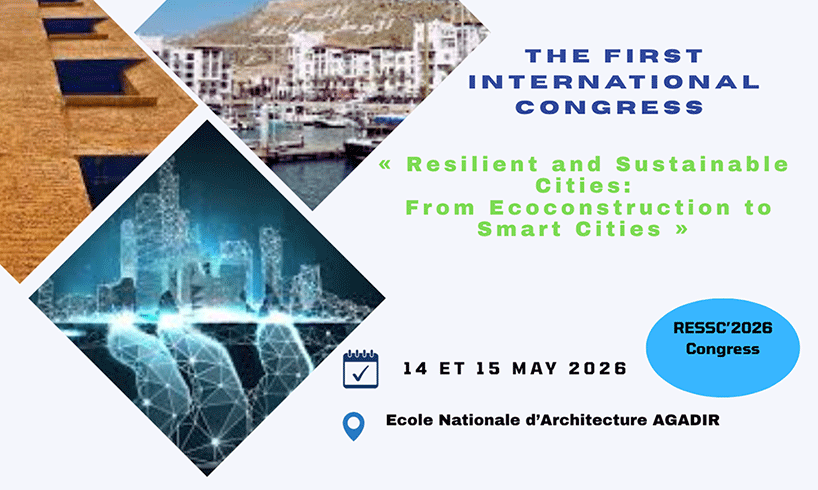
Resilient and Sustainable Cities: From Ecoconstruction to Smart Cities
Agadir , Morocco – 14 – 15 May 2026
→ New Deadline for abstracts submission January 15, 2026
Welcome to RESSC’2026 – 1ᵗʰ International Congress on Resilient and Sustainable Cities
Main Theme:
About the congress
The world we live in is experiencing enormous climate change due to industrialization and rapid urbanization that do not respect the environment, leading to drought and fires, desertification, floods and tsunamis, melting ice caps, and rising sea levels, which in turn have social consequences on people’s health and make populations more vulnerable to disease and unemployment. This highlights the necessity to reevaluate our strategies in various domains, especially in construction, since the building sector is responsible for over 40 % of energy consumption and plays a major role in greenhouse gas emissions. This is the rationale behind this conference, which aims to foster dialogue between researchers, institutions, industry, and civil society to restore traditional knowledge and skills and modernize them in the construction sector to achieve more sustainable, resilient, and smart cities. At the heart of this thinking, eco-construction and energy transition are key drivers for reducing the carbon footprint of the building sector and improving the efficiency of urban systems. Advances in innovative materials, heat transfer, energy storage, and smart energy management are paving the way for new forms of sustainable architecture that combine technical performance with environmental efficiency. This meeting will look at the synergies between technological innovation, bioclimatic design, and sustainable development in order to design cities that can optimize their resources, adapt to climate change, and offer a more harmonious and equitable living environment for their citizens.
This conference also aims to promote and consolidate scientific research in the fields of eco-construction, the environment, sustainability, smart systems, and sustainable, resilient, and smart cities. Promote and encourage exchanges between researchers, industry, and institutions; disseminate scientific knowledge and highlight new research ideas among industry and researchers; and encourage innovation while bringing research closer to civil society. The congress also believes that traditional knowledge and skills must be restored and that construction approaches and methods must be renewed to become more technical and modern.
E-mail: [email protected]
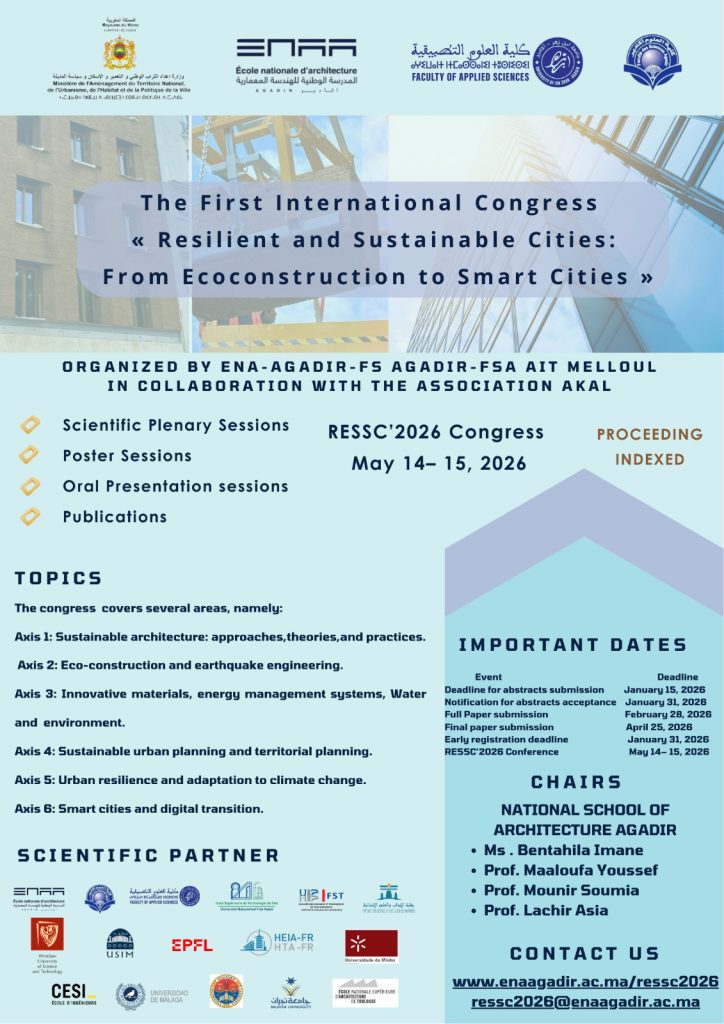
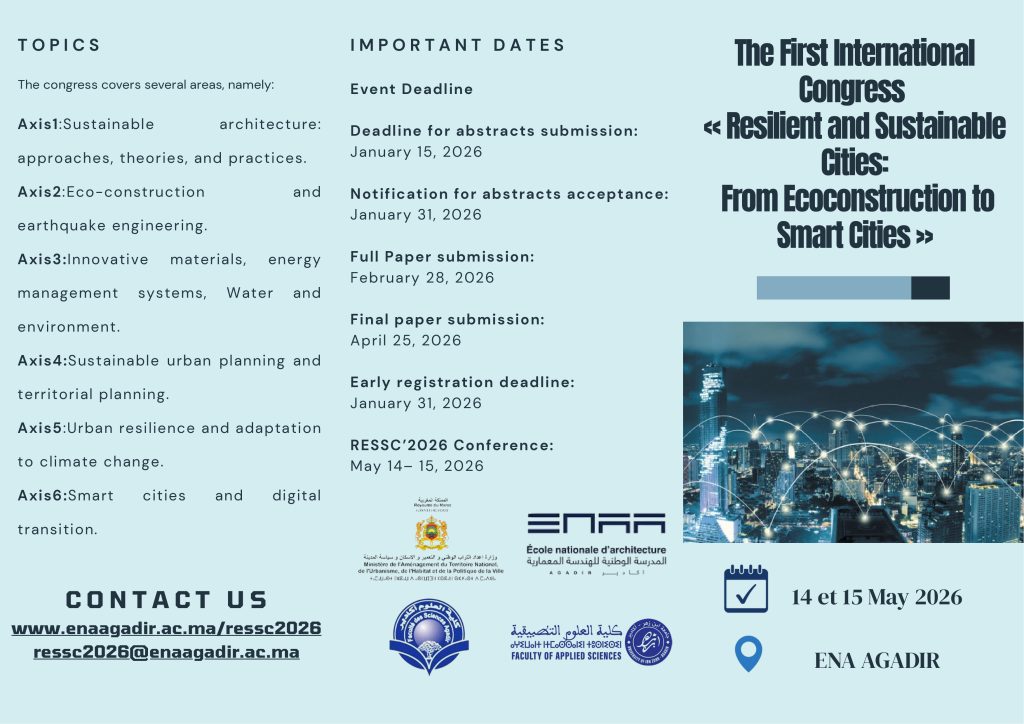
The congress covers several areas, namely:
Axis 1: Sustainable architecture: approaches, theories, and practices
Sustainable architecture is not just about designing functional buildings. It incorporates a holistic vision, encompassing ecological performance, user comfort, and environmental preservation. The search for solutions that reduce the ecological footprint while maximizing human well-being is at the heart of this approach.
- Architectural design and theory;
- Architectural environments;
- Bioarchitecture;
- Bioclimatic architecture and passive design.
Axis 2: Eco-construction and earthquake engineering
Promoting an eco-responsible approach to construction through the use of sustainable materials and architectural concepts integrated into the environment, taking into account earthquake risk.
- Ecological, bio-based, and geo-based materials;
- Construction innovations;
- Reuse, recyclability, circular economy in construction;
- Earthquake-resistant construction;
- Earthquake-resistant construction;
- Life cycle analysis and carbon footprint of materials.
Axis 3: Innovative materials, energy management systems, water and environment
Explore scientific and technological advances in high-performance materials, heat transfer, energy storage, water and environment which are essential levers for energy-efficient buildings and infrastructure.
- Heat transfer, heat exchange, and fluid dynamics;
- Thermal simulation and modeling for sustainable design;
- Thermal and electrical energy storage systems;
- High-performance energy materials and multifunctional composites;
- Material characterization;
- Renewable energy systems;
- Sustainable rehabilitation and enhancement of built heritage;
- Water recovery and reuse;
- Water desalination;
- Water consumption management and optimization;
- Water-efficient equipment;
- Water quality and health in buildings.
Axis 4: Sustainable urban planning and territorial planning
Promote urban planning that integrates the environment, mobility, and social cohesion for balanced cities that are pleasant to live in.
- Eco-responsible development of urban and peri-urban areas;
- Sustainable mobility: public transport, soft mobility, and intermodality;
- Green spaces, urban biodiversity, and ecological networks;
- Integrated resource management: water, energy, waste;
- Social diversity, inclusion, and quality of urban life.
Axis 5: Urban resilience and adaptation to climate change
Develop strategies to enable cities to withstand, adapt to, and transform in the face of climate hazards and environmental crises.
- Risk management: floods, urban heat, natural disasters;
- Resilient urban planning and climate adaptation;
- Nature-based solutions and green infrastructure;
- Post-crisis reconstruction and flexible planning;
- Public policy, governance, and regulatory frameworks for resilience.
Axis 6: Smart cities and digital transition
Harnessing digital technologies to promote sustainability and urban performance, while preserving data ethics and sovereignty.
- Smart technologies ( IoT, AI, big data) promoting sustainability;
- Smart systems for energy, water, and waste management;
- Digital modeling of the territory: from BIM to CIM;
- Connected mobility and smart infrastructure;
- Cybersecurity, protection, and governance of urban data;
- Digital governance and connected citizen participation.
| Event | Deadline |
| Deadline for abstracts submission | January 15, 2026 |
| Notification for abstracts acceptance | January 31, 2026 |
| Full Paper submission | February 28, 2026 |
| Final paper submission | April 25, 2026 |
| Early registration deadline | January 31, 2026 |
| RESSC’2026 Conference | may 14– 15, 2026 |
Authors are invited to submit their original research contributions to The first International Congress « Resilient and Sustainable Cities: From Ecoconstruction to Smart Cities » :
- Guidelines for Authors:
All submissions must be prepared in English and formatted according to the provided templates. - Abstracts should be formatted according to the template provided below.
Templates for Short Papers are available for download under the “Publication Opportunities” section. - Each paper will be peer-reviewed by at least two independent reviewers.
- All manuscripts will be checked for plagiarism.
- Accepted papers must be presented at the congress (oral or poster presentation).
- An online session may be arranged for non-Moroccan participants who can provide justification for their inability to attend the conference in person.
- At least one author of each accepted paper must register and present the work.
- A maximum of two articles per author is accepted.
- Selected high-quality papers will be invited for publication in special issues or conference proceedings journal.
Download Abstract Template
Tip For Title & Abstract Instructions
Submission Form
Publication Opportunities
- All short papers will be peer reviewed. All accepted short papers will be included in the conference proceedings, which will be published in the MATEC Web of Conferences, an open-access publication series, and will be submitted for indexing in Scopus and Web of Science.
- Selected high-quality papers will be invited for publication in special issues or conference proceedings journal .
- Number of short pages should range between 6 and 10 pages. Articles exceeding these limits may be excluded from publication.
- Short papers should be prepared in a single-column format using a 170 × 250 mm paper size. The template can be downloaded below. Further instructions for authors are available at: https://www.matec-conferences.org/for-authors#anchor_Instructions-ffor-authors
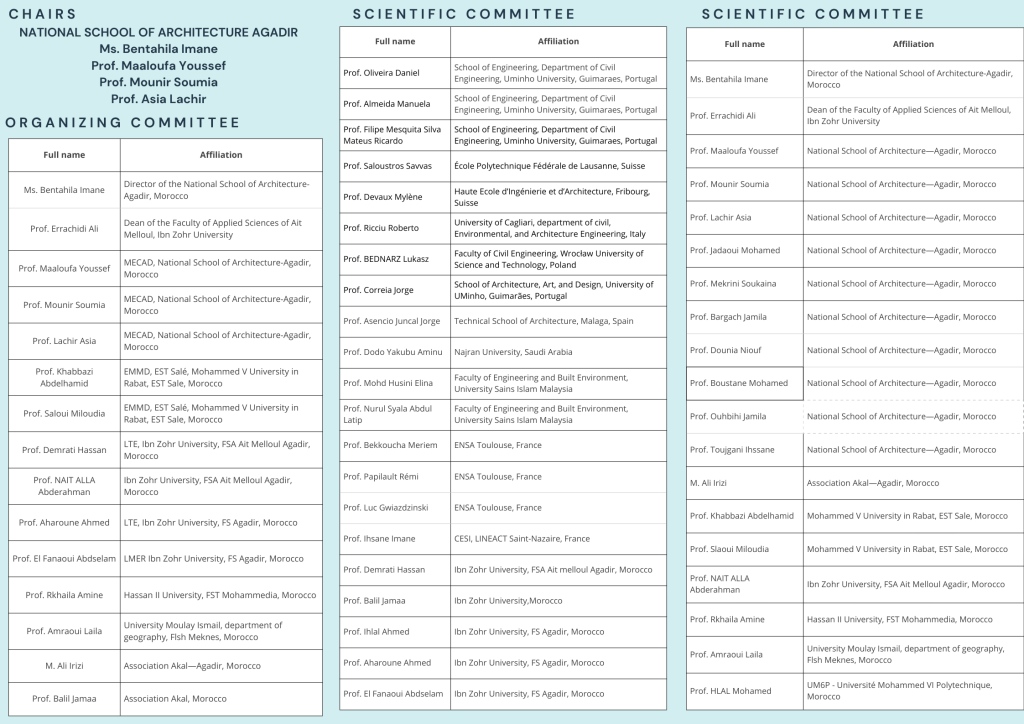
| Full name | Affiliation |
| Ms. Bentahila Imane | Director of the National School of Architecture—Agadir, Morocco |
| Prof. Maaloufa Youssef | National School of Architecture—Agadir, Morocco |
| Prof. Mounir Soumia | National School of Architecture—Agadir, Morocco |
| Prof. Lachir Asia | National School of Architecture—Agadir, Morocco |
Scientific Committee
| Full name | Affiliation |
| Prof. Oliveira Daniel | School of Engineering, Department of Civil Engineering, Uminho University, Guimaraes, Portugal |
| Prof. Almeida Manuela | School of Engineering, Department of Civil Engineering, Uminho University, Guimaraes, Portugal |
| Prof. Filipe Mesquita Silva Mateus Ricardo | School of Engineering, Department of Civil Engineering, Uminho University, Guimaraes, Portugal |
| Prof. Saloustros Savvas | École Polytechnique Fédérale de Lausanne, Suisse |
| Prof. Devaux Mylène | Haute Ecole d’Ingénierie et d’Architecture, Fribourg, Suisse |
| Prof. Ricciu Roberto | University of Cagliari, department of civil, Environmental, and Architecture Engineering, Italy |
| Prof. BEDNARZ Lukasz | Faculty of Civil Engineering, Wrocław University of Science and Technology, Poland |
| Prof. Correia Jorge | School of Architecture, Art, and Design, University of UMinho, Guimarães, Portugal |
| Prof. Asencio Juncal Jorge | Technical School of Architecture, Malaga, Spain |
| Prof. Dodo Yakubu Aminu | Najran University, Saudi Arabia |
| Prof. Mohd Husini Elina | Faculty of Engineering and Built Environment, University Sains Islam Malaysia |
| Prof. Nurul Syala Abdul Latip | Faculty of Engineering and Built Environment, University Sains Islam Malaysia |
| Prof. Bekkoucha Meriem | ENSA Toulouse, France |
| Prof. Papilault Rémi | ENSA Toulouse, France |
| Prof. Luc Gwiazdzinski | ENSA Toulouse, France |
| Prof. Ihsane Imane | CESI, LINEACT Saint-Nazaire, France |
| Prof. Demrati Hassan | Ibn Zohr University, FSA Ait melloul Agadir, Morocco |
| Prof. Balil Jamaa | Ibn Zohr University,Morocco |
| Prof. Ihlal Ahmed | Ibn Zohr University, FS Agadir, Morocco |
| Prof. Aharoune Ahmed | Ibn Zohr University, FS Agadir, Morocco |
| Prof. El Fanaoui Abdselam | Ibn Zohr University, FS Agadir, Morocco |
| Ms. Bentahila Imane | Director of the National School of Architecture—Agadir, Morocco |
| Prof. Errachidi Ali | Dean of the Faculty of Applied Sciences of Ait Melloul, Ibn Zohr University |
| Prof. Maaloufa Youssef | National School of Architecture—Agadir, Morocco |
| Prof. Mounir Soumia | National School of Architecture—Agadir, Morocco |
| Prof. Lachir Asia | National School of Architecture—Agadir, Morocco |
| Prof. Jadaoui Mohamed | National School of Architecture—Agadir, Morocco |
| Prof. Mekrini Soukaina | National School of Architecture—Agadir, Morocco |
| Prof. Bargach Jamila | National School of Architecture—Agadir, Morocco |
| Prof. Dounia Niouf | National School of Architecture—Agadir, Morocco |
| Prof. Boustane Mohamed | National School of Architecture—Agadir, Morocco |
| Prof. Oubihi jamila | National School of Architecture—Agadir, Morocco |
| Prof. Toujgani Ihssane | National School of Architecture—Agadir, Morocco |
| M. Ali IRIZI | Association Akal—Agadir, Morocco |
| Prof. Khabbazi Abdelhamid | Mohammed V University in Rabat, EST Sale, Morocco |
| Prof. Slaoui Miloudia | Mohammed V University in Rabat, EST Sale, Morocco |
| Prof. NAIT ALLA Abderahman | Ibn Zohr University, FSA Ait Melloul Agadir, Morocco |
| Prof. Rkhaila Amine | Hassan II University, FST Mohammedia, Morocco |
| Prof. Amraoui Laila | University Moulay Ismail, department of geography, Flsh Meknes, Morocco |
| Prof. HLAL Mohamed | UM6P - Université Mohammed VI Polytechnique, Morocco |
Organizing Committee
| Full name | Affiliation |
| Ms. Bentahila Imane | Director of the National School of Architecture-Agadir, Morocco |
| Prof. Errachidi Ali | Dean of the Faculty of Applied Sciences of Ait Melloul, Ibn Zohr University |
| Prof. Maaloufa Youssef | MECAD, National School of Architecture-Agadir, Morocco |
| Prof. Mounir Soumia | MECAD, National School of Architecture-Agadir, Morocco |
| Prof. Lachir Asia | MECAD, National School of Architecture-Agadir, Morocco |
| Prof. Khabbazi Abdelhamid | EMMD, EST Salé, Mohammed V University in Rabat, EST Sale, Morocco |
| Prof. Saloui Miloudia | EMMD, EST Salé, Mohammed V University in Rabat, EST Sale, Morocco |
| Prof.Demrati Hassan | LTE, Ibn Zohr University, FSA -Ait Melloul Agadir, Morocco |
| Prof. NAIT ALLA Abderahman | Ibn Zohr University, FSA-Ait Melloul Agadir, Morocco |
| Prof. Aharoune Ahmed | LTE, Ibn Zohr University, FS-Agadir, Morocco |
| Prof. El Fanaoui Abdselam | LMER Ibn Zohr University, FS-Agadir, Morocco |
| Prof. Rkhaila Amine | Hassan II University, FST Mohammedia, Morocco |
| Prof. Amraoui Laila | University Moulay Ismail, department of geography, Flsh Meknes, Morocco |
| M. Ali IRIZI | Association Akal-Agadir, Morocco |
| Prof. Balil Jamaa | Association Akal, Morocco |

Daniel Oliveira
Minho University School of Engineering Department of civil engineering– Portugal
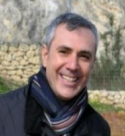
Roberto Ricciu
University of Cagliari Department of Engineering and Architecture- Italy.

Savvas Saloustros
Ecole Polytechnique Fédérale de Lausanne-Swiss.

Elina Mohd Husini
University Sains Islam Malaysia Faculty of Engineering and Built Environment- Malaysia.
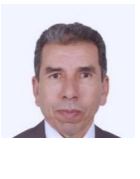
Ahmed Ihlal
University Ibn Zohr Faculty of Sciences Agadir Morocco.
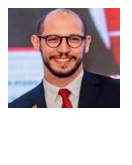
Badr Ben Hichou
citiXperts, Harmony Technology, Rabat, Morocco
Registration and Payment Information
| Category | Students | Researchers/Academics |
| Public universities (Morocco) | 650 MAD | 1000 MAD |
| Others | 150 EUR | 300 EUR |
| Category | Students | Researchers/ Academics |
| Public universities (Morocco) | 650 MAD | 1000 MAD |
| Others | 150 EUR | 300 EUR |
Registration includes: full access to conference sessions, coffee breaks, proceedings publication and participant kit.
All participants are kindly requested to complete the registration process by following the three steps below:
Step 1 — Bank Transfer
Please pay the registration fees via bank transfer using the following details:
– Account Holder: ASSOCIATION AKAL ARCHITECTURE DURABLE
– Account Number: 62000011188
– RIB: 011010000006200001118880
– SWIFT Code: BMCEMAMC
– Bank Name: MA64 011010000006200001118880
Step 2 — Registration Form
After paying the registration fees, please fill out the official RESSC 2026 Registration Form.
Step 3 — Important Notes
Please mention the following reference in your payment receipt:
“RESSC’2026 Congress – [Participant’s Full Name] – [Paper ID] – [Category: Student / Academic / Industrial ] – [Date]”
and send a copy to: [email protected]
Your registration will be confirmed after all steps are completed.
Currency exchange or bank collection fees are the responsibility of the participant.
All participants are kindly requested to complete the registration process by following the three steps below:
Step 1 — Bank Transfer
Please pay the registration fees via bank transfer using the following details:
– Account Holder: ASSOCIATION AKAL ARCHITECTURE DURABLE
– Account Number: 62000011188
– RIB: 011010000006200001118880
– SWIFT Code: BMCEMAMC
– Bank Name: MA64 011010000006200001118880
Step 2 — Registration Form
After paying the registration fees, please fill out the official RESSC 2026 Registration Form.
Step 3 — Important Notes
Please mention the following reference in your payment receipt:
“RESSC’2026 Congress – [Participant’s Full Name] – [Paper ID] – [Category: Student / Academic / Industrial ] – [Date]”
and send a copy to: [email protected]
Your registration will be confirmed after all steps are completed.
Currency exchange or bank collection fees are the responsibility of the participant.
Our Sponsors